Books:
Paul Verhoeven’s Cinema of Violence (Bloomsbury, 2026)
This book explores the films of Paul Verhoeven, the Dutch director of provocative and vividly imagined films such as Turkish Delight (1973), Keetje Tippel (1975), RoboCop (1987), Basic Instinct (1992), Showgirls (1995), Starship Troopers (1997), Black Book (2006), and Elle (2016). Paul Verhoeven’s Cinema of Violence studies a wide range of themes across filmmaker Verhoeven’s work, including his cinematic approaches to violence, his adaptation of literature, his work in notable genres such as  science fiction and the war film, his work with actors and direction of performances, and more. The book also traces in Verhoeven’s work a career-long interest in religion. Although an avowed atheist, Verhoeven has been obsessed with the image of Jesus Christ in nearly all of his films, a theme in his cinema that dovetails with his academic study Jesus of Nazareth. Exploring the breadth of the director’s career, this book encompasses everything from his early short works as a student filmmaker to the most recently completed Benedetta (2021), a French-language film based on Judith C. Brown’s 1986 academic volume Immodest Acts.
“A wide-ranging, immersive study of a filmmaker who has long eluded sustained investigation despite – as Rybin explores – compelling particularities of style, approach, and subject matter. This book provides the most thoroughgoing and definitive study of Verhoeven’s oeuvre to date. Rybin’s keen yet nuanced and exploratory analyses allow us to contemplate new ways of seeing and thinking about these films, challenging well-worn critical assumptions.” -Dominic Lennard, Senior Teaching Fellow, University of Tasmania, Australia, and author of Brute Force: Animal Horror Movies (2019)
Playful Frames: Styles of Widescreen Cinema (Rutgers University Press, 2023)
Exploring the relationship between aspect ratio and subject matter, Playful Frames shows how filmmakers can make puckish use of widescreen technology. All four of the directors studied in the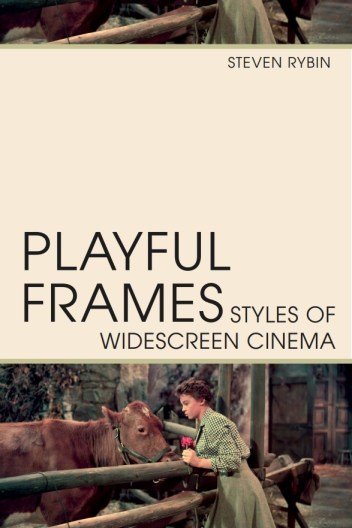 book — Jean Negulesco, Blake Edwards, Robert Altman, and John Carpenter — creatively inhabited the nooks and crannies of CinemaScope and Panavision for several decades, and in doing so reimagined popular genres and brought a range of intermedial interests to cinema (painting, performance, and music).
“Until I began reading Steve Rybin’s surprising and steadily adventurous book, I had never thought of linking widescreen frames and their accompanying camera movements with playfulness. His bravura inquiry enlarges and richly complicates the ludic possibilities, in addition to offering fresh, provocative readings of four very different American directors’ works. Rybin writes with such infectious gusto and has a splendid ability to make the visual details whose mystery he probes come alive on the page.” -George Toles, University of Manitoba
“With detailed and lively formal analyses, Rybin shows the often surprising ways in which four very different directors used the possibilities of the wider aspect ratio to orchestrate viewer attention for comedy, terror, drama, characterization, and spectacle. Playful Frames is an invaluable addition to our understanding of widescreen aesthetics, expanding beyond viewer immersion to questions of reflexivity, genre, and intermediality.” -Lisa Bode, author of Making Believe: Screen Performance and Special Effects in Popular Cinema
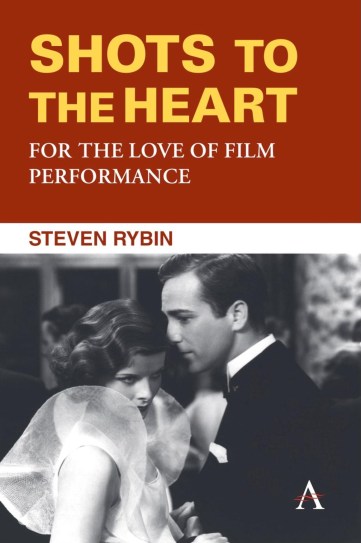 Shots to the Heart: For the Love of Film Performance (Anthem Press, 2022)
This book continues my project, begun in Gestures of Love, of exploring how the work of the film actor inspires, provokes, and refigures our feelings and thoughts about the cinema. The book closely considers the art of film performance in relation to the viewer’s sensitive and creative experiences of films. This short book (or long essay!) explores acting across a range of different types of movies, including silent cinema, art cinema, Hollywood films, and independent cinema.
“Here is an example of that rare book in Film Studies: one that dares to bring the academic rigor of the film scholar into contact with the adoring pleasure of the cinephile. In Shots to the Heart, Steven Rybin eloquently and convincingly—indeed lovingly—explores the elusive, ineffable quality of what is so often simply (dis)regarded as the ‘actor’s magic’.”—Daniel Varndell, Professor, English Literature, University of Winchester, UK.
“This is a meditation on not only the love of performance but also the love of writing about cinema itself. Rybin interweaves personal reflection and incisive analysis in such a way that the reader is compelled, in turn, to retrace their own relationship to beloved moments in film. Eloquent and thought-provoking.”—Ana Salzberg, Senior Lecturer in Film Studies and Visual Culture, University of Dundee, Scotland.
“A little book with big ideas and a wonderful addition to scholarship on performance, auteur theory, and star studies.”—Matthew Leggatt, Lecturer, Department of English, Creative Writing and American Studies, University of Winchester, UK.
Geraldine Chaplin: The Gift of Film Performance (Edinburgh University Press, 2020)
The most distinguished actor among Charlie Chaplin’s children, Geraldine Chaplin has created a striking performative presence and screen personality across international cinema. In shifting cinematic contexts and through collaborations with major film directors, she playfully evokes the memory of her iconic father, while establishing her own distinctive screen art. Geraldine Chaplin: The Gift of Film Performance looks closely at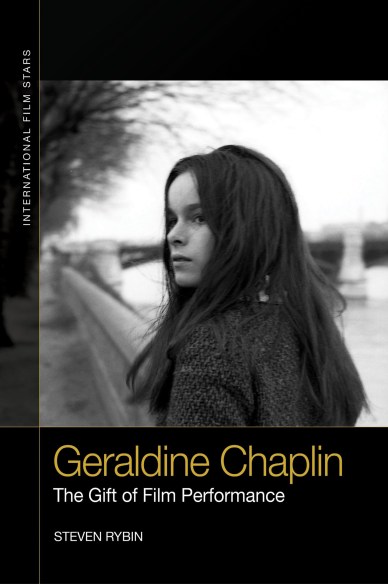 Chaplin’s remarkable screen achievements, and includes close readings of her performances across a decades-long career in the movies. Films analyzed include Doctor Zhivago, Peppermint Frappé, Cría Cuervos, Nashville, Remember My Name, Noroît, Talk to Her, and more.
“I have never read a better analysis of a major actor’s career than Steven Rybin’s Geraldine Chaplin: The Gift of Film Performance. His account of Chaplin’s remarkably diverse body of work is filled with surprises, making the story of her collaborations with David Lean, Carlos Saura, Robert Altman, Alan Rudolph and numerous other directors not only illuminating, but gripping. Especially rewarding are the parallels he establishes not only with her father’s career but with Charlie Chaplin’s major performances.” – George Toles, University of Manitoba
Steven Rybin has done us all a service by bringing Geraldine Chaplin’s career and art so thoughtfully into view. Through a series of revelatory close readings, he traces her globe-spanning, seven-decade career, which encompassed turns in British, Spanish, French, Italian, Hollywood, and avant-garde cinemas and included career-defining roles in Doctor Zhivago and Nashville. Throughout, Rybin recognizes Chaplin as an avatar of film history: her earliest screen appearance came as a child extra in her father’s Limelight; one of her latest saw her playing her own grandmother in Richard Attenborough’s Chaplin. Framing Chaplin’s career through its distinct echoes with that of her legendary father, Rybin enables us to see how Geraldine Chaplin both embraced and transcended that legacy to become a preeminent screen artist in her own right. – Donna Kornhaber, University of Texas at Austin
Gestures of Love: Romancing Performance in Classical Hollywood Cinema (SUNY Press, 2017)
Gestures of Love considers the viewer’s enchantment with charismatic actors in film as the starting point for closely analyzing the performance of love in movies. The book discusses  several of cinema’s most beloved on-screen movie couples, including Katharine Hepburn and Cary Grant, Myrna Loy and William Powell, Carole Lombard and John Barrymore, Gene Tierney and Dana Andrews, Lauren Bacall and Humphrey Bogart, and Rock Hudson and Dorothy Malone. Using the classical genres of screwball comedy, film noir, and the family melodrama as touchstones, Gestures of Love places the depiction of romance in films into dialogue with the viewer’s own emotional bond to the actors on the screen. The book offers rich new analyses of such classic films as Bringing Up Baby, The Thin Man, Twentieth Century, Laura, To Have and Have Not, Tea and Sympathy, Written on the Wind, and more.
Hamlet Lives in Hollywood: John Barrymore and the Acting Tradition Onscreen (a collection of new essays on the actor, co-edited with Murray Pomerance; Edinburgh University Press, 2017)
John Barrymore’s influence on screen and stage in the early twentieth century is  incalculable. His performances in the theatre defined Shakespeare for a generation, and his transition to cinema brought his theatrical performativity to both silent and sound screens. This book, a collection of fifteen original essays on the film performances and stardom of John Barrymore, redresses this lack of scholarship on Barrymore by offering a range of varied perspectives on the actor’s work. Looking at his performances and influence from the perspectives of gender studies, psychoanalysis, queer studies and performance analysis, Hamlet Lives in Hollywood represents a major attempt by contemporary scholars to come to terms with the ongoing vitality of John Barrymore’s work in our present day
The Cinema of Hal Hartley: Flirting with Formalism (Wallflower Press, 2016)
 Over the course of nearly thirty years, Hal Hartley has cultivated a reputation as one of America’s most steadfastly independent film directors. From his breakthrough films – The Unbelievable Truth, Trust, and Simple Men – to his ‘Henry Fool’ trilogy, Hartley has honed a rigorous, deadpan, and instantly recognizable film style informed by both European modernism and playful revisions of Classical Hollywood genres. Featuring new essays on this important director and his films, this collection explores Hartley’s work from a variety of aesthetic, cultural, and economic contexts, while also looking closely at his collaborations with actors, the contexts of his authorial reputation, his reworking of the romantic comedy and other genres, and the shifting economics of his filmmaking.
This book, up-to-date through Hartley’s latest film, Ned Rifle, includes a selection of new essays from leading scholars on independent cinema, exploring the director’s early work as well as reflections on his cinema in connection with new theories and approaches to independent filmmaking. Covering the entire trajectory of his career, including both his features and short films, the book also includes new readings of several of Hartley’s seminal films, including Amateur, Flirt, and Henry Fool.
Lonely Places, Dangerous Ground: Nicholas Ray in American Cinema (a collection of new essays on the director, co-edited with Will Scheibel; SUNY Press, 2014)
 The director of such classic Hollywood films as In a Lonely Place, Johnny Guitar, and Rebel Without a Cause, Nicholas Ray nevertheless remained on the margins of the American studio system throughout his career, and despite his cult status among auteurist critics and cinephiles, he has also remained at the margins of film scholarship. Lonely Places, Dangerous Ground offers twenty new essays by international film historians and critics that explore the director’s place in the history of the Hollywood industry and in the larger institution of cinema, as well as a 1977 interview with Ray that has never before been published in its entirety in English.
Michael Mann: Crime Auteur (Scarecrow Press, 2013)
 Michael Mann first made his mark as a writer for such television programs as Starsky and Hutch, Police Story, and Vegas. In 1981 he made his feature film directing debut with the James Caan thriller Thief, and in the 1980s he served as a writer and executive producer for the groundbreaking programs Miami Vice and Crime Story. Though he has delved into other genres, Mann’s career as a writer, producer, and director has consistently focused on criminal activity, from small-time hoods and professional thieves to corporate manipulators and serial killers.
Michael Mann: Crime Auteur looks at the television programs and films that Mann has stamped with his personal signature. This book closely examines the themes and techniques used in films such as Manhunter, Heat, The Insider, Collateral, The Last of the Mohicans and Ali. A revised and significantly expanded edition of The Cinema of Michael Mann (2007), this book includes new chapters on Public Enemies and the big screen version of Miami Vice, as well as Mann’s work on the shows Crime Story and Luck.
[The first version of this book, The Cinema of Michael Mann, is still available and up-to-date through Mann’s 2006 film, Miami Vice.]
Terrence Malick and the Thought of Film (Lexington Books, 2011)
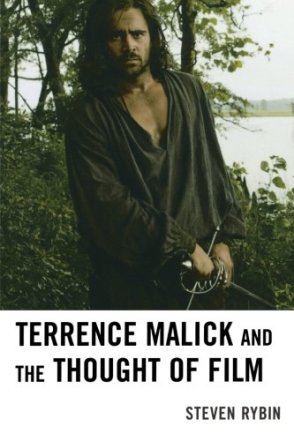 Terrence Malick has created a remarkable body of work that enables imaginative acts of philosophical interpretation. This book looks closely at the dialogue between Malick’s films and our powers of thinking, showing how his work casts the philosophy of thinkers such as Stanley Cavell, Martin Heidegger, Walter Benjamin, André Bazin, Edgar Morin, and Immanuel Kant in new cinematic light.
With a special focus on how the voices of Malick’s characters move us to thought, Terrence Malick and the Thought of Film offers new readings of his films and places Malick’s work in the context of recent debates in the interdisciplinary field of film and philosophy.
 Steven Rybin